
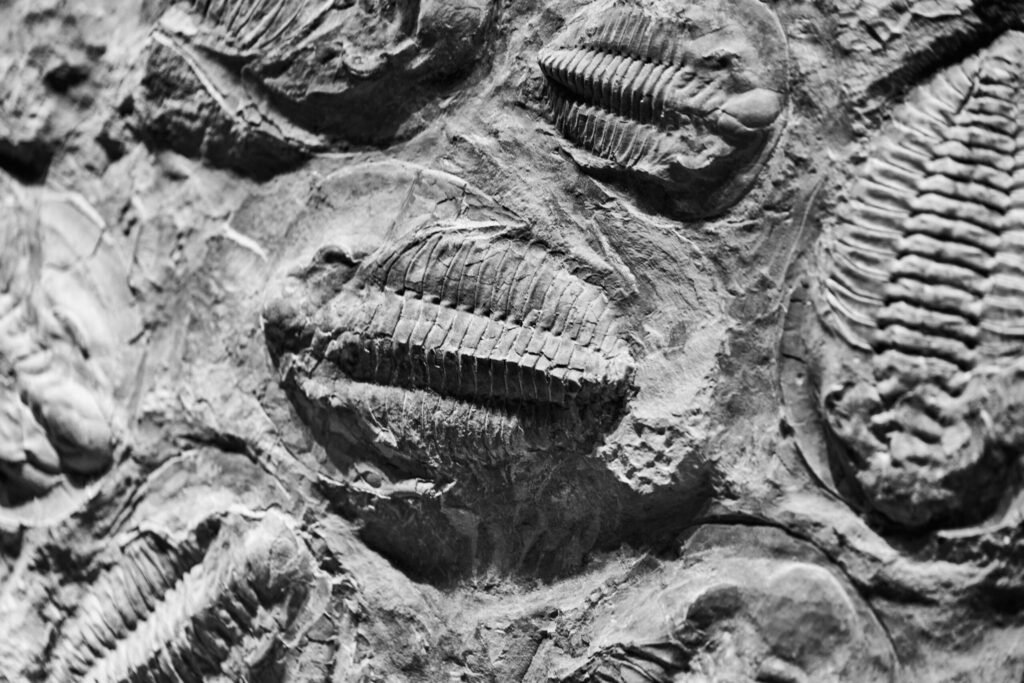
Today, evolutionary theory is presented as a well-supported scientific theory. Students are often shown neat diagrams of how life progressed, from simple single-celled organisms to the dazzling diversity we see today. However, a crucial piece of evidence – the fossil record – is actually riddled with puzzling gaps, challenging the very narrative that many have come to accept as settled truth.
The Gaps In The Fossil Record
In his book On the Origin of Species, Charles Darwin himself recognized a serious problem with his theory. He admitted that, if his idea were true, then “the number of intermediate varieties, which have formerly existed on the earth, [must] be truly enormous.” Yet, he conceded that “[g]eology assuredly does not reveal any such finely graduated organic chain; and this, perhaps, is the most obvious and gravest objection which can be urged against my theory.” Darwin tried to explain this away by blaming the “extreme imperfection” of the geological record.1
Fast forward to today, over 160 years later, and the situation still has not improved much for Darwin’s theory. Despite vast advancements in paleontology and countless new fossil discoveries, the fossil evidence for these crucial evolutionary intermediates remains elusive. Instead of a gradual and continuous transition from one species to another, what the fossil record shows is the sudden appearance of fully formed major groups of organisms.
Ernst Mayr, one of the leading evolutionary biologists of the 20th Century, admitted that:
Wherever we look at the living biota, whether at the level of the higher taxa or even at that of the species, discontinuities are overwhelmingly frequent. Among living taxa there is no intermediacy between whales and terrestrial mammals, nor between reptiles and either birds or mammals. All 30 phyla of animals are separated from each other by a gap. There seems to be a large gap between the flowering plants (angiosperms) and their nearest relatives. The discontinuities are even more striking in the fossil record. New species usually appear in the fossil record suddenly, not connected with their ancestors by a series of intermediates...This raises a puzzling question: Why does the fossil record fail to reflect the gradual change one would expect from evolution?2
Missing Links
In response to this challenge, evolutionists continue to uphold Darwin’s line of defense that only a fraction of the fossil-bearing strata is presently exposed at the Earth’s surface. They also argue that most dead animals and plants would have been eaten by scavengers or decayed before they could be fossilized. This argument conveniently ignores the fact that millions of fossils have been unearthed to date — the Smithsonian National Museum of Natural History alone has 40 million fossil specimens in their collection! 3
Evolutionists also point to the occasional discovery of “missing links” as evidence that macroevolution happens and transitional fossils exist, even if they are rare. Examples given include Archaeopteryx, the evolutionary origin of whales, and the Australopithecine ancestors of man (e.g. Lucy).
The problem with these examples is that they are often based on scant evidence and filtered through a pre-existing evolutionary lens. We will examine them in detail below.
1. Archaeopteryx
For years, Archaeopteryx has been paraded as the textbook example of a “missing link” – the perfect transitional fossil proving birds evolved from reptiles/ dinosaurs. Discovered in 1861, this primitive bird from the Upper Jurassic (around 145 million years ago) had wings and feathers like modern birds, but also reptilian traits like teeth instead of a beak and a long bony tail.
However, this interpretation depends heavily on how we define “birds” and “reptiles.” In the past, these were seen as two distinct categories. However, many scientists today classify birds as simply avian dinosaurs. As the Natural History Museum points out, the line between birds and non-avian dinosaurs can be vague, and these categories are ultimately invented by humans.4 Many non-avian dinosaurs had feathers, wishbones and specialised joints in the wings while early birds also had teeth, long bony tails and clawed hands like their non-avian counterparts.5
Furthermore, the scientific consensus today is that birds likely had already appeared before Archaeopteryx. For a time, bird-like dinosaurs, primitive birds and early modern birds all co-existed. Archaeopteryx itself eventually went extinct without leaving any modern descendants.6
As such, Archaeopteryx is not a “missing link” bridging separate categories, but rather just another bird species within the broader dinosaur family that has no direct relation to modern birds.
2. Evolutionary Origin of Whales
Evolutionists often point to the evolutionary tree of whales as a textbook example of clear evolutionary transitions—from land mammals to fully aquatic giants. But the reality is far less straight forward.
For many years, the fossil record of whales was, in fact, remarkably poor. As National Geographic noted, “the fossils necessary to flesh out the details of the transition were entirely missing. All of the known fossil whales were fully-aquatic. No whale with limbs or other transitional features had been found.”7
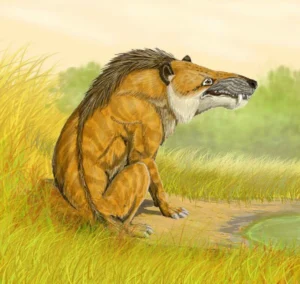
Despite this lack of evidence, in 1966, evolutionary biologist Leigh Van Valen proposed that whales descended from an extinct group of hoofed, carnivorous mammals known as Mesonychids. The evidence for this came from perceived similarities in the fossilized teeth of Pakicetus (supposedly an early whale ancestor) and Mesonychids. This Mesonychid-whale connection was confidently taught for years, even appearing in books as established fact.
However, in 2001, what was once widely accepted was overturned and the proposed lineage of whale evolution was reconstructed. This change came about when scientists noticed similarities in the ankle bones of early whales and Artiodactyls (a group of hoofed animals, including hippos, deer, and pigs). Suddenly, the Mesonychid hypothesis was dropped, and scientists now widely believe whales descended from Indohyus (a genus of Artiodactyl) instead.8
This shift highlights a critical weakness with evolutionary trees. The supposedly clear evolutionary lineage of whales is not built on solid evidence, but on minor structural similarities that are selectively interpreted to fit a pre-existing evolutionary framework.
3. Australopithecine
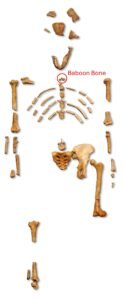
Lucy, the famous Australopithecus afarensis fossil unearthed in 1974, is often presented as a key early human ancestor with both ape-like and human-like traits. Her human-like knee joint combined with her smaller skull size and relatively short stature (107cm) has been used to argue for her transitional status.9
However, a closer look at the evidence reveals that this conclusion is far from settled.
Firstly, to suggest her height alone precludes her from being “fully human” ignores modern human diversity. Individuals with dwarfism (ranging from 80-147cm in adult height)10 are undeniably human, despite their short stature. Medical conditions like microcephaly can also result in a smaller than normal head size in humans.
Secondly, a surprising 2015 discovery revealed that one of Lucy’s bones actually belonged to a baboon.11,12 The fact that such a fundamental misidentification of one of evolution’s most iconic figures persisted for more than 40 years raises serious questions. It points to a lack of independent verification and rigorous peer review in the interpretation of evolutionary evidence.
Ultimately, if evolution truly involved countless small steps, the fossil record should be teeming with thousands of obvious transitional forms, clearly illustrating every incremental shift. Instead, we are only presented with a handful of doubtful examples of “missing links”. This stands in stark contrast to the overall pattern of the fossil record, which reveals the sudden appearance of most major organism groups.
The Cambrian Explosion
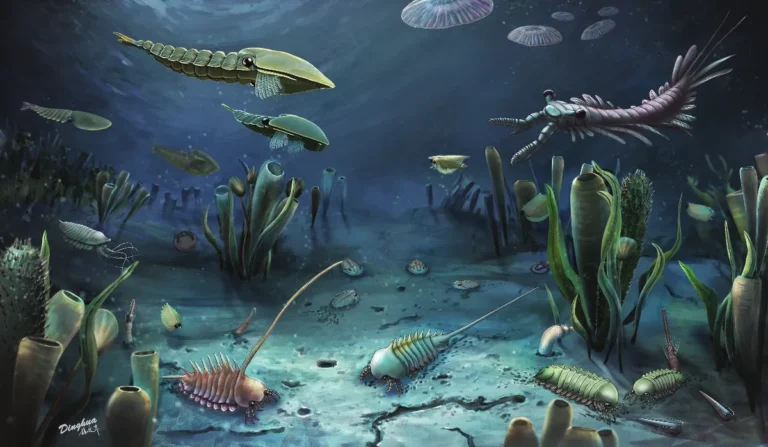
The most famous example of this sudden appearance is the Cambrian Explosion, which occurred roughly 550 to 530 million years ago. In this relatively short geological window (as compared to Earth’s history), all modern animal phyla appeared in the fossil record. It did not happen gradually as Darwin predicted, but suddenly and simultaneously.13 (In 2021, scientists found that even the phylum Bryozoa appeared during the Cambrian period, when the previous understanding was that it appeared after the Cambrian period)14.
What is particularly striking is that the creatures that emerged during the Cambrian Explosion were not just simple lifeforms. They had differentiated and jointed appendages (like legs and fins), distal senses (such as eyes), nervous systems, and even brains allowing for sensing and motion.15
Perhaps Earlier Creatures Were Not Fossilized?
The Cambrian Explosion’s tight 20-million-year geological timeframe presents a challenge to evolutionary theory, leaving little room for the gradual development of animal body plans. This constraint has led some evolutionists to hypothesize that perhaps the body plans arose earlier in the Ediacaran period (635–541 million years ago), but were not fossilized due to their soft bodies. This led to the illusion of the sudden evolution of all animal phyla during the Cambrian period.16
However, this explanation fails under scrutiny. Many Cambrian fossils themselves were soft-bodied, yet they were preserved in the fossil record. Additionally, scientists have discovered fossils of ancient bacteria and protozoans that predate the Cambrian period by 3 billion years.17 If microscopic, soft-bodied organisms from billions of years ago can be fossilized, then there is no reason why the pre-Cambrian ancestors cannot be fossilized, if they existed.
Post-Cambrian Puzzle: Why No New Body Plans?
Another mystery for evolutionists is why no new animal phyla have appeared since the Cambrian Explosion. According to Darwinian theory, the five major extinction events in Earth’s history should have provided vacated niches that offered opportunities for new body plans to evolve. Yet, what we observe is that all subsequent developments have been confined to variations within existing phyla. Evolutionary theory struggles to explain why new body plan innovation at the phyla level stopped after the Cambrian period.18
A Different Perspective: Progressive Creationism
While the gaps in fossil record and the Cambrian explosion puzzle evolutionists, it aligns naturally with a different understanding of life’s origins – that of progressive creationism. According to the Bible, God created life in stages: sea creatures first, then birds, followed by land animals, before finally concluding with the creation of humans. This order aligns with the existing fossil record.
Crucially, the Bible also states that God created animals “according to their kinds”. While the Bible did not specify what “kind” refers to, it could be interpreted as a broader category19. This explains why the fossil record shows that all subsequent variations have been confined to within each existing phyla, and no new phylum has emerged since the Cambrian period. It also explains why each major group of organisms is distinct and separate, with no intermediates.
So, where does the fossil record truly lead us? The sudden appearance of complex life forms in the fossil record, the lack of true transitional fossils, and the absence of new phyla since the Cambrian explosion are all significant challenges to the theory of evolution. The question is whether we are willing to face where that evidence genuinely points, even if it means re-evaluating the very bedrock of our understanding.
Related Posts
References
1 Darwin, C. (1859). On the origin of species. https://www.gutenberg.org/files/1228/1228-h/1228-h.htm
2 Mayr, E. (2001). What evolution is. Basic Books. https://philpapers.org/rec/MAYWEI-4
3 Collections Overview. (n.d.). Smithsonian National Museum of Natural History. https://naturalhistory.si.edu/research/paleobiology/collections-overview
4 Archaeopteryx. (n.d.). Natural History Museum. https://www.nhm.ac.uk/discover/dino-directory/archaeopteryx.html
5 The living dinosaurs. (2020, December 12). The Australian Museum. https://australian.museum/learn/dinosaurs/the-living-dinosaurs/
6 Ibid.
7 Black, R. (2011, October 4). Evolutionary treasures locked in the teeth of early whales. National Geographic. https://www.nationalgeographic.com/science/article/evolutionary-treasures-locked-in-the-teeth-of-early-whales
8 Ibid.
9 Rupe, C., & Sanford, J. (2017). Contested bones. FMS Publications.
10 Frequently Asked Questions. (n.d.). Little People of America. https://www.lpaonline.org/faq-#:~:text=Q:%20What%20is%20the%20definition,’8%20to%204’8.
11 Meyer, M. R., Williams, S. A., Smith, M. P., & Sawyer, G. J. (2015). Lucy’s back: Reassessment of fossils associated with the A.L. 288-1 vertebral column. Journal of Human Evolution, 85, 174–180. https://doi.org/10.1016/j.jhevol.2015.05.007
12 Barras, C. (2015, April 10). Baboon bone found in famous Lucy skeleton. New Scientist. https://www.newscientist.com/article/dn27325-baboon-bone-found-in-famous-lucy-skeleton/
13 Willmore, K. E. (2012). The body plan concept and its centrality in Evo-Devo. Evolution: Education and Outreach, 5(2), 219–230. https://doi.org/10.1007/s12052-012-0424-z
14 Zhang, Z., Zhang, Z., Ma, J., Taylor, P. D., Strotz, L. C., Jacquet, S. M., Skovsted, C. B., Chen, F., Han, J., & Brock, G. A. (2021). Fossil evidence unveils an early Cambrian origin for Bryozoa. Nature, 599(7884), 251–255. https://doi.org/10.1038/s41586-021-04033-w
15 Trestman, M. (2013). The Cambrian Explosion and the origins of embodied cognition. Biological Theory, 8(1), 80–92. https://doi.org/10.1007/s13752-013-0102-6
16 Willmore, K. E. (2012). The body plan concept and its centrality in Evo-Devo. Evolution: Education and Outreach, 5(2), 219–230. https://doi.org/10.1007/s12052-012-0424-z
17 Schroeder, G. L. (2009). The science of God: The convergence of scientific and biblical wisdom. Simon and Schuster.
18 Willmore, K. E. (2012). The body plan concept and its centrality in Evo-Devo. Evolution: Education and Outreach, 5(2), 219–230. https://doi.org/10.1007/s12052-012-0424-z
19 Dealing with the subject of evolution. (2006, December 11). The Methodist Church in Singapore. https://www.methodist.org.sg/methodist-message/dealing-with-the-subject-of-evolution/