

Darwin’s theory of evolution explains how living organisms might have evolved from simpler, pre-existing lifeforms. However, it does not explain how the first living cell came about. It simply assumes that the first living cell existed. Darwin himself had no natural explanation for the origin of life, as he wrote in On the Origin of Species, “[p]robably all the organic beings which have ever lived on this earth have descended from some one primordial form, into which life was first breathed by the Creator.” 1
The fact that evolution could not explain how the first single-celled microorganism arose was not seen as a major issue in Darwin’s time. Many of Darwin’s peers believed that a cell was just a simple blob of protoplasm made up of basic chemicals like carbon dioxide, nitrogen, and oxygen.2 The idea that such a simple lifeform could spontaneously arise did not seem far-fetched.
The Complexity Of A Cell
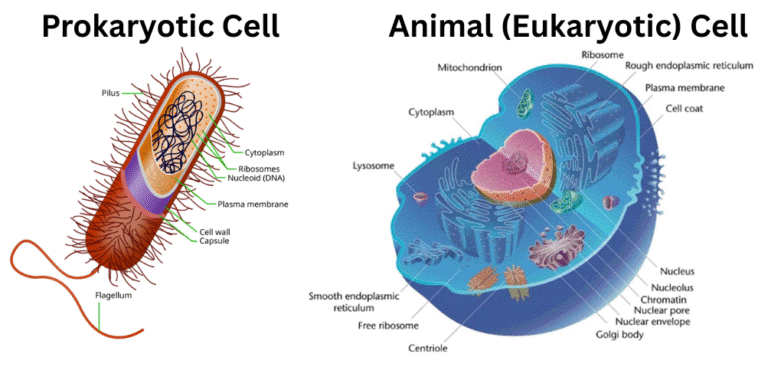
However, science has come a long way since then. Today, we know that a cell is very complex. Even the simplest prokaryotic cell has the following features3:
- Molecular machines, such as ribosomes, to synthesize proteins
- Metabolic pathways, such as glycolysis, to generate and manage energy
- A system for storing genetic information (DNA)
DNA: The Code of Life
In particular, the discovery of DNA’s structure in 1953 made the origin of life even harder to explain. Overnight, the amount of biological information requiring explanation exploded. For instance, the human genome contains approximately 3 billion base pairs of DNA —an astounding amount of information equivalent to 800 dictionaries or 10,000 novels4.
Bill Gates once said, “DNA is like a computer program, but far, far more advanced than any software ever created.”5 Just as software encodes digital information using binary digits (0s and 1s), DNA conveys genetic information using four nucleotides: A, C, T and G. Every three-nucleotide segment, called a codon, maps to a specific amino acid.
| Software Code | Genetic Code (DNA) | |
|---|---|---|
| Components | 2 digits (0, 1) | 4 nucleotides (A, C, T, G) |
| Mapping | Arbitrary: not dictated by physics 8 bits to 1 character (for ASCII) | Arbitrary: not dictated by chemistry 3 nucleotides to 1 amino acid |
| Examples | A: 0100 0001 B: 0100 0010 C: 0100 0011 | Glycine: GGA Tryptophan: TGG Stop signal: TGA 6 |
| Code executed by | Computer | Cell |
| Written by | Programmer | God? |
When it comes to software, we recognize that it relies on a set of rules established by human intelligence. For instance, the ASCII code represents the letter A as 0100 0001, but it could just as easily have been something else (like 1111 1111). The mapping is not inherently dictated by physics but by convention. Similarly, when it comes to language, the letters themselves are inherently meaningless. A string like “gbqorgnkjf dq ibsipqobe” is just gibberish, while a string like “this is a meaningful phrase” conveys functional information, but only because the letters are arranged according to predetermined rules set by English speakers.
The same logic applies to DNA. It is a coded information system that transmits genetic instructions. Critically, the relationship between codons and amino acids is not chemically determined. There is no inherent chemical reason why TGG should code for amino acid tryptophan, or why TGA should signal a stop. This mapping is arbitrary and not inherent to the DNA molecule. The question is, who came up with the rules?
Whether it is a computer program or a book, we recognize that there is human intelligence behind it. So why should DNA — the most advanced code we have ever encountered — be the one exception? The most reasonable conclusion is that DNA, too, was the product of an intelligent mind. This explains why, Francis Collins, director of the Human Genome Project and a former agnostic who became a Christian, referred to DNA as “the language of God.” 7
Abiogenesis: Miller-Urey Experiment
Some might argue that while evolution is currently unable to explain the origin of life, there is progress through the study of abiogenesis — the study of how life could have arisen naturally from non-living matter. They often point to the Miller-Urey experiment (1953). Electric sparks were passed through a mixture of gases thought to resemble the early Earth’s atmosphere, and this produced a few simple amino acids, which are the basic building blocks of proteins. From this experiment, some claim that life could have spontaneously arisen by chance.8
However, this greatly underestimates the complexity involved in what is required to produce life. To give an analogy, producing a few amino acids is like finding a few scattered bricks and claiming that one is on the verge of building a skyscraper. Yes, bricks are the basic building blocks of buildings, but a skyscraper requires millions of bricks, along with blueprints, construction machinery, plumbing, wiring, and construction crews who follow the plan. Similarly, amino acids are just the raw materials. To build even a single functional protein, one needs hundreds of amino acids arranged in an exact sequence, and the protein has to fold correctly into a 3D structure.
Let us now take a closer look at the odds of forming a protein by chance. Even a relatively small protein chain contains about 150 amino acids, each selected from 20 possible options. That results in 20150 (or roughly 10195) possible combinations — a number far exceeding the estimated number of protons and neutrons in the entire observable universe (about 1080).
Only a tiny fraction of these permutations (roughly 1 in 1077) will fold into stable, useful, three-dimensional proteins, driven by precise chemical forces. Biologist Douglas Axe calculated that even if every bacterium that ever lived (estimated at 1040) each contributed one mutation, the chance of producing even a single functional protein is just 1 in 1037. In other words, practically zero.9
As Scientific American stated in 1979, “merely to create a bacterium would require more time than the Universe might ever see if chance combinations of its molecules were the only driving force.”10
The RNA World Hypothesis
Furthermore, there is a fundamental chicken-and-egg problem that evolution has yet to solve. DNA holds the instructions to build proteins, but proteins are also required to interpret DNA. Which came first?
Some scientists propose the “RNA-first” scenario. RNA can carry genetic information like DNA, and can perform limited catalytic functions like proteins. This can potentially resolve the chicken-and-egg problem.
However, the RNA world hypothesis faces significant challenges. RNA is inherently unstable, much more so than DNA, and its enzymatic properties are far more limited than those of proteins. Biochemist Harold Bernhardt summarized the problems in his paper “The RNA world hypothesis: the worst theory of the early evolution of life (except for all the others)“, acknowledging that “the problems associated with the RNA world hypothesis are well known.”11
A Desperate Alternative: Aliens
Faced with all these problems surrounding the origin of life question, some scientists such as Francis Crick (a Nobel laureate who co-discovered DNA) suggested directed panspermia— the idea that perhaps an advanced alien civilization deliberately seeded life on Earth.12
While this might seem to “solve” the origin of life problem on Earth, it merely shifts the question elsewhere. How did extraterrestrial life originate on a different planet?
Furthermore, even Crick himself admitted that this idea lacked evidence, “the scientific evidence is inadequate at the present time to say anything about the probability.”13
Intelligent Design
The origin of life is one of the greatest mysteries in science, a question for which evolution offers no answer. When we examine the complexity of a cell, the genetic code of DNA, the mathematical improbability of proteins arising by chance, and the chicken-and-egg problem between DNA and proteins, one conclusion emerges: these are not the hallmarks of blind chance or undirected natural processes, but rather compelling evidence pointing to a powerful and intelligent Creator.
Related Posts
References
1 Darwin, C. (1859). On the origin of species (2nd ed.). https://www.gutenberg.org/files/1228/1228-h/1228-h.htm
2 Meyer, S. C. (2013). Darwin’s Doubt: The Explosive Origin of Animal Life and the Case for Intelligent Design. Harper Collins.
3 Alberts, B., & Stein, W. (2025, July 24). Cell. Encyclopedia Britannica. https://www.britannica.com/science/cell-biology
4 The human genome can fill 800 dictionaries or 10,000 novels! (n.d.). MedGenome. https://diagnostics.medgenome.com/blog/what-is-genome/#:~:text=Did%20you%20know%20that%20if,us%20is%20just%20as%20vast.
5 Gates, B. (1996). The road ahead. Penguin Books.
6 DNA codon table. (n.d.). ResearchGate. https://www.researchgate.net/figure/DNA-codon-table-https-wwwwpclipartcom-medical-microscopic-genetic-codepnghtml_fig2_360757456
7 ABC News. (2006, July 15). Excerpt: “The Language of God.” https://abcnews.go.com/GMA/story?id=2192678&page=1
8 Akre, K., & Rafferty, J. (n.d.). Miller-Urey experiment. Encyclopedia Britannica. https://www.britannica.com/science/Miller-Urey-experiment
9 Gelernter, D. (2019). Giving up Darwin. Claremont Review of Books. https://claremontreviewofbooks.com/giving-up-darwin/
10 Folsome, C. (1979). Life : origin and evolution : readings from Scientific American. W.H. Freeman.
11 Bernhardt, H. S. (2012). The RNA world hypothesis: the worst theory of the early evolution of life (except for all the others)a. Biology Direct, 7(1), 23. https://doi.org/10.1186/1745-6150-7-23
12 Is there life elsewhere, and did it come here? (1981, November 29). The New York Times. https://www.nytimes.com/1981/11/29/books/is-there-life-elsewhere-and-did-it-come-here.html
13 Crick, F., & Orgel, L. (1973). Directed panspermia. Icarus, 19(3), 341–346. https://doi.org/10.1016/0019-1035(73)90110-3