
The American Museum of Natural History states that “[h]umans and chimps share a surprising 98.8 percent of their DNA” and that the two species are “so similar because [they] are so closely related” as they are “descended from a single ancestor species that lived six or seven million years ago”. The museum goes on to say that “Human and chimp DNA is nearly identical when you compare the bands on chromosomes, the bundles of DNA inside nearly every cell.”
At first glance, this near-identical genetic similarity seems to provide ironclad evidence for common descent. However, while the 98.8% (other sources use 98-99%, so we will use 98.5%) figure is a staple of biology textbooks and popular media, recent genomic research suggests this statistic is far from correct. When we look at the actual data, the “nearly identical” narrative begins to unravel.
Problems With The 98.5% Figure
The widely cited 98.5% figure is actually a relic of the 1970s, established long before the genomes of humans and chimpanzees were sequenced in 2003 and 2005 respectively. These early indirect estimates focused on protein-coding regions (the parts of DNA that make proteins), which account for a mere 1–2% of human genome. Yet the vast majority of our DNA is non-coding. Once dismissed as “junk,” we now know these regions play critical roles in gene expression and genomic organization—and it is precisely these regions that humans and chimpanzees differ most drastically.
Moreover, a high similarity in protein-coding regions is not unique to the human-chimpanzee relationship. All mammals share a high similarity in protein-coding regions, because we all have the same biological need to eat, breathe and reproduce.
Now that the genomes of humans and chimpanzees have been sequenced, why is the 98.5% figure still cited? The answer lies in methodological cherry-picking. The 98.5% figure is derived from only looking at the single nucleotide substitutions. Several crucial types of genetic differences, mainly indels, structural variations, and unalignable regions, are not accounted for when deriving the 98.5% figure. This artificially inflates the genetic similarity between humans and chimpanzees.
Accounted For
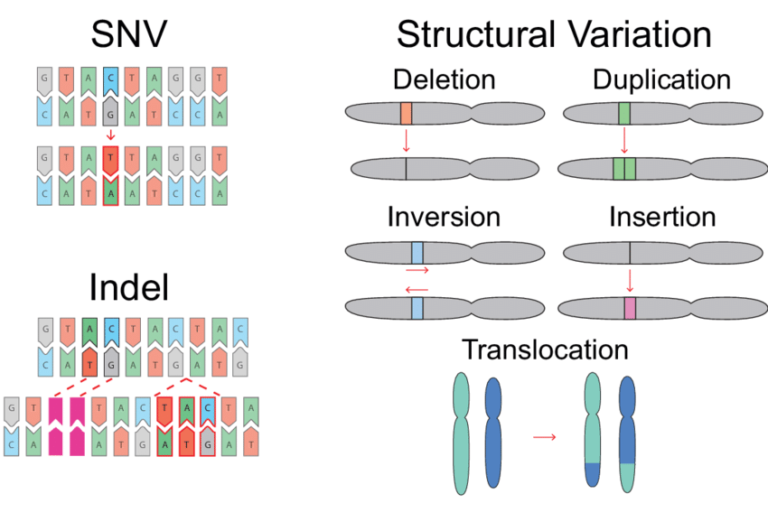
- Single Nucleotide Variants (SNVs): one or a few nucleotides differ in parts of the genomes that align
Not Accounted For
- Insertions & Deletions (Indels): small sequences that are found in one genome but not the other.
- Structural Variation: Larger-scale rearrangements like inversions, translocations, as well as large-scale insertions and deletions, including copy number variants (CNVs). CNVs are regions where the number of copies of sequences vary among individuals.
- Unalignable Regions: Sections of DNA that are so different that they cannot be aligned or compared side by side at all.
A More Accurate Comparison
The first draft of the human genome sequence was released in 2001, and finalised in 2003, under the Human Genome Project. Technically, the human genome sequence obtained in 2003 was only 92% complete. About 8% of repetitive regions in the genome remained unsequenced due to technological limitations. It was not until 2022 that a breakthrough was achieved and the entire human genome was completely sequenced.
Armed with fully sequenced genomes and better methodology, recent scientific studies have finally moved away from the inaccurate 98% figure and revealed that the genetic gap is significantly wider than previously believed.
- Britten (2002): 95% similarity
One of the earliest serious attempts to directly quantify human–chimpanzee genome similarity using proper methodology came from molecular biologist Roy J. Britten in 2002. He compared five bacterial artificial chromosomes from the chimpanzee genome with the human genome. A limitation was that the length of the DNA compared was a tiny fraction of the entire Chimpanzee genome, as the Genome Project was still ongoing at that point in time.
Britten’s widely cited paper stated that the old 98.5% figure was “probably in error.” He concluded that a more accurate estimate for the specific DNA he was able to compare was around 95% similarity. Single-nucleotides substitutions accounted for 1.4% of difference, while the inclusion of indels added another 3.4% of additional divergence.
Crucially, this 95% figure only applied to the DNA that could be aligned. Britten noted that approximately 8% of the chimpanzee sequences he studied were so divergent they could not be matched with the human genome at all. If the unalignable regions were included, the genetic similarity would drop even further.
Despite these limitations, Britten’s work was a critical first step in demonstrating that the genetic similarity between human and chimpanzees is lower than the widely purported 98.5% figure.
- Yoo et al. (2025): 85% similarity
In 2025, scientists Yoo et al. fully sequenced the genomes of six ape species, including chimpanzees. This, together with the fully sequenced human genome in 2022, finally allowed for a full comparison between the two genomes. Their results were published in the prestigious Nature journal.
Here is what they found: “sequence comparisons […] revealed greater divergence than previously estimated”. While the single-nucleotide variant (SNV) percentage was indeed around 1.5-1.6%%, there was an additional gap divergence of 12.5% -13.3% between the ape and human genome, as a result of indels, structural variants and unalignable regions.
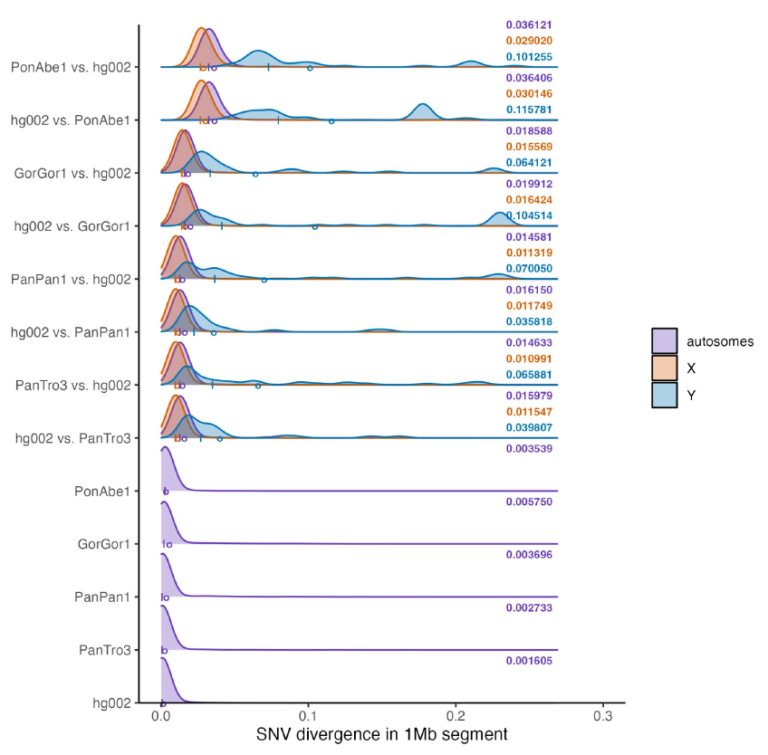
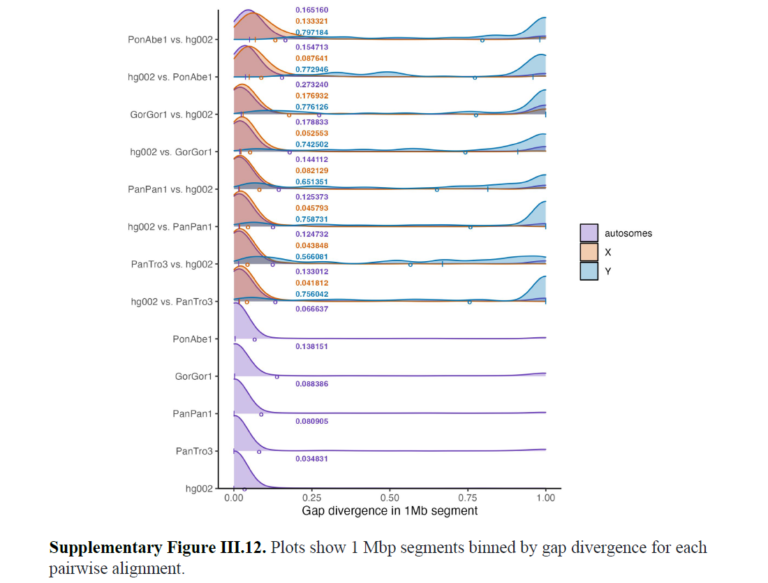
This marks the first time that the gap divergence has been quantified. Once the massive gap divergence has been factored in, the total genetic similarity between human and chimp DNA drops to around 85%*, which is a far-cry from the 98.5% figure. In fact, the difference is now almost ten times bigger.
Counterargument: Intraspecies Gap Divergence Is Huge too
In response, evolutionists (this site for instance) like to counter that the same graph in Yoo’s study shows that the there is a whopping 13.8% gap divergence just among gorillas alone. For chimpanzees, the intraspecies gap divergence is around 8%, and for human beings, it is around 3.5%.
Their argument goes like this: since the gap divergence between humans and chimpanzees is about the same as the gap difference between any two gorillas, and no one believes that every gorilla is its own species, gap divergence is not a meaningful measure of the relatedness of two genomes. Hence, it should be disregarded.
The Counterargument Misunderstands The Methodology
At first glance, the counterargument makes sense. If the 14% gap divergence among gorillas is just noise, then the 13% gap divergence between humans and chimpanzees should also be considered noise. However, upon closer inspection of Yoo’s study, one would realise that equating intraspecies gap divergence with interspecies gap divergence is like comparing apples to oranges.
To arrive at the intraspecies gap divergence (i.e. among gorillas), the researchers took a single gorilla and compared the chromosomes that are inherited from the mother with the chromosomes inherited from the father. The 14% gap in gorillas measures heterozygosity—the internal diversity a single organism carries. Gorillas have a high heterozygosity because they have a lot of transposable elements (genes that jump around to new locations) and satellite DNA (highly repetitive sequences that can contract or expand).
Using books as an analogy, two gorillas are like two copies of the same book. In one book, some sentences are shifted to a different part of a chapter (transposable elements). Additionally, instead of having 1 full stop at the end of a sentence, there are 10 extra full stops (satellite DNA). These minor changes do not change the main content of the book, yet they are still counted in the intraspecies gap divergence, resulting in a lot of “noise”.
On the other hand, when measuring the interspecies gap divergence, such as between humans and chimpanzees, the researchers cannot just compare a human individual with another chimpanzee individual. That will not be representative of the population. In fact, if they did so, the genetic similarity percentage would change every time they picked a different human or chimpanzee.
Hence, the researchers did the genomic equivalent of finding a population average. They validated the human genome that they used (HG002) with multiple other human genomes. Doing so allowed them to keep only the traits that are universal to all humans and exclude the mutations unique to an individual i.e. the noise. Using our analogy, the researchers essentially found the most authoritative copy of a book and stripped away those extra full stops.
The result is that even after stripping away the individual noise, a 15% interspecies gap divergence remains between humans and chimpanzees. It includes 185 human specific gene families that are not found in apes, which potentially hold the explanation for our intellectual capacity.
The researchers also found a Pterv1 virus sequence that is present in all great apes, but is not found in humans. This contradicts the evolutionary story. If humans and chimpanzees have a closer evolutionary relationship and supposedly share a common ancestor after diverging from the gorilla lineage, then why do gorillas and chimpanzees have the Pterv1 virus sequence, but humans do not?
Can chimpanzees learn language?
If humans and chimpanzees have a high degree of genetic similarity, then it is logical to expect chimpanzees to have at least a rudimentary capacity for language. However, because the 98.5% similarity is a product of incomplete and cherry-picked data rather than biological reality, scientists who set out with this premise were left chasing a mirage.
A well-known example is that of Nim Chimpsky. In the 1970s, psychologist Herbert S. Terrace set out to challenge the idea that language is unique to humans by teaching a chimpanzee named Nim Chimpsky American Sign Language. Raised in a human-like environment, Nim was taught over a hundred signs and could combine them into short sequences like “Nim eat banana.” For a time, the project seemed promising.
However, after reviewing thousands of videotaped sessions, Terrace was forced to draw a different conclusion. Nim’s use of signs was largely imitative, prompted, and reward-driven. It did not understand grammar or syntax, nor did it construct original, meaningful sentences. Ultimately, apes just could not acquire language.
How Should We Make Sense Of 85% Similarity?
A small 1.5% genetic difference supports the evolutionary story that humans evolved from an ape-like ancestor. On the other hand, a 15% difference represents a significant biological discontinuity that evolution has a hard time explaining. That is why the 98.5% myth persists, despite it not being factual. Evolutionists need it to persist or the evolutionary story falls apart. It also shows how “sticky” a narrative can be, even when the underlying data has moved on.
Yet, clinging to an outdated and inaccurate estimate when modern genomic sequencing shows a 15% difference is intellectually dishonest and a disservice to the public. If the data shows that humans are quantitatively and qualitatively distinct, withholding that information prevents us from appreciating the complexity of our genome and how we view human dignity, morality, and our place in the universe.
It stops us from understanding what makes us unique. Or, who made us unique.
The 85% genetic similarity between humans and chimpanzees points to a common Designer, one who created life with shared components. All mammals, not just chimpanzees and humans, share a large portion of their DNA. This is because all mammals need to perform the same core biological functions like eating, breathing, and reproducing. From a design perspective, it makes sense for the Creator to simply use a common molecular toolkit.
Yet it is the 15% difference that our defining human traits reside: our capacity for language, abstract reasoning, morality, and worship. Humans alone write books, compose music, tell stories, form governments, and ask questions like “Why am I here?” and “Is there a God?” No other species does this, not even chimpanzees. These are features found only in humans, not because we are slightly more advanced animals, but because we are qualitatively different from animals.
We are made in the image of God (Genesis 1:27).
References
https://www.amnh.org/exhibitions/permanent/human-origins/understanding-our-past/dna-comparing-humans-and-chimps
Hotspots of Human Mutation – Scientific Figure on ResearchGate. Available from: https://www.researchgate.net/figure/Types-of-Genetic-Variation-Single-nucleotide-variants-SNVs-and-indels-are-changes-that_fig1_346898467 [accessed 1 Mar 2026]
[Refer to Supplementary Notes III.12, the rows labelled with hg002 (Human) and PanTro3 (Chimpanzee), autosomes’ (non-sex chromosomes) divergence].
*Calculated by taking 13.3% gap divergence (using human as the base) + [1.6% SNV divergence (using human as the base) * 86.7% alignable region] = 14.7% total divergence between the non-sex chromosomes of humans and chimpanzees.
How Similar Are Human and Chimp Genomes, Really? Quantifying Genetic Difference Isn’t Straightforward